On Raising My Prices, Being “Too Expensive,” and Knowing Your Worth as a Facilitator
There was a moment recently that stayed with me.
I had just increased the price of my Sound Healer Training, and on the very next student connection call, for the first time in over three years of teaching, someone said to me that the training was too expensive and too long.
I’ll be honest, I didn’t feel triggered, but I did feel something shift. Not doubt, but clarity.
Because this is what happens when you begin to fully stand in your work. At some point, you are no longer for everyone, and that has to be okay.
I still offer flexible payment plans because I genuinely want this work to be accessible to those who feel the calling. But the deeper truth is that this path requires a full-body yes. Not just financially, but in time, energy, and commitment.
The truth about my training
Before speaking to facilitators, I want to be transparent about what I offer and where it sits.
I’ve taken time to look at the market, both in the UK and internationally, and the reality is that I am not positioned at the top end of pricing. For a long time, I was actually one of the cheapest, and eventually that stopped feeling aligned. Not because I simply wanted to charge more, but because the training itself had grown far beyond what it once was.
This is now an eight-day, in-person training. It is immersive, practical, and deeply rooted in both sound and energy work, which is still something rarely taught together in the UK. You are not just learning techniques; you are actively practicing, holding space, and being supported as you find your way as a facilitator.
There is no need to invest in instruments beforehand, as everything is provided. You are surrounded by sound, given time to explore, and guided into actually working one-to-one with others. The focus is not on consuming information, but on embodiment. On experience. On becoming.
And that simply cannot be rushed.
The evolution behind the price
It also feels important to share how much this training has evolved over time.
When I first started, it was a two-day course held in a cold warehouse with very limited instruments. It was simple, and at that stage, the price reflected that.
Since then, everything has expanded.
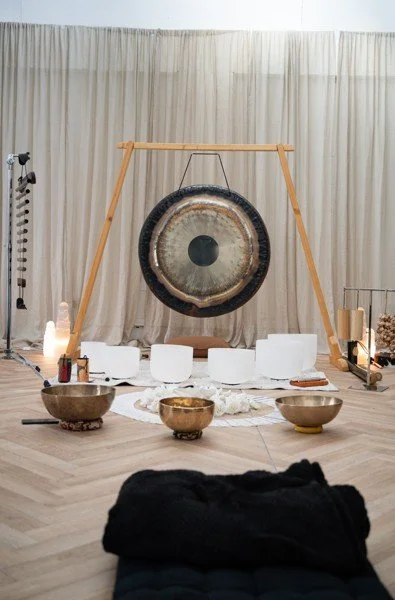
The training is now held in my own dedicated teaching space, created to support this work properly. It is warm, comfortable, and intentionally designed, with underfloor heating, supportive equipment, and a large library of instruments that students can fully access throughout the training.
But the biggest shift has not just been the space, it has been the depth of the work itself.
Over the years, I have continued to study, to refine my approach, and to deepen my understanding of both sound and energy. All of that is now integrated into the training. The structure is stronger, the guidance is clearer, and the level of support I offer is far beyond what it once was.
So the price has not simply increased. The experience has evolved.
And my intention is to offer the best possible environment for someone to truly step into this work, not just touch the surface of it, and that continues beyond the classroom.
Why I don’t believe in fast-track facilitation
There is a growing tendency to make everything quicker and more convenient, but facilitation does not work like that.
Sound is not something you learn by watching. It is something you learn through feeling, through listening, through holding space and being held at the same time. It is learned through repetition, through moments of uncertainty, and through finding your own rhythm within the work.
That process cannot be condensed without losing something essential.
I could shorten the training, but the depth would change, and that is not a compromise I am willing to make.
The real conversation: worth
What this moment really brought forward is something much bigger than one training or one conversation.
At some point, every facilitator is faced with the question of worth.
Do you adjust yourself to meet what feels more comfortable for others, or do you stand in the value of what you know you offer?
You are the one who decides your worth. Not the market, not social media, not your peers, and not your clients.
You choose where you place yourself. No one will knock on your door telling you to raise your prices.
And most people place themselves too low, not because they lack value, but because it feels safer there.
My own journey with money
I understand this deeply because I have lived it.
There was a time when I charged £25 for a group sound healing session. Today, I can charge £1250.
That shift did not come from simply deciding to raise my prices. It came from doing the deeper work around my relationship with money.
I had to look at where I was undercharging to feel accepted, where I was holding myself back to avoid being questioned, and where I believed that spirituality and financial expansion could not coexist.
That required honesty, discomfort, and a willingness to change.
What I tell my students
In the early stages, I actually encourage my students not to focus on charging high prices straight away.
For the first six months, I suggest offering sessions for free or at a low cost. Not because their work has no value, but because that time is about exploration. It is where you learn what you enjoy, who you want to work with, and how you want to show up.
It is your research phase.
But staying there too long becomes another form of limitation. At some point, you have to decide what your work is worth, not based on fear or comparison, but based on your energy, your integrity, your experience, and the impact you are creating.
The moment of decision
That call brought me into a very clear internal decision.
Do I soften this? Do I adjust the price it to make it easier her and other to say yes? Or do I trust what I know in my heart is the right price for what I offer?
I chose to trust.
Not from ego, but from alignment.
And I also trust that if someone truly wants to work with me, they will find a way, whether that is through planning, prioritising, or using the flexible payment options that are available.
What changes when you raise your prices
What is often not spoken about is that when you raise your prices, everything else has to rise with it.
It is not just about the number. It is about how you show up, how you hold your spaces, how you communicate, and how you support the people you work with. It is about the clarity of your vision and the standards you set for yourself.
You cannot ask people to meet you at a higher level if you are not fully meeting yourself there.
That has been the real shift for me. My work has become clearer, more intentional, and more grounded in what I truly want to build. I am investing in my appearance, my decoration and the way I show up for my community outside of the sessions and trainings.
Where I stand now
After three years of teaching, working with over 200 students, and consistently receiving beautiful amazing feedback, I trust what I offer.
I have seen the impact of this work, and I know the depth it holds.
So yes, my prices have risen.
Not to exclude, but to align.
And with that comes a simple truth. Not everyone is meant to be your client, and not everyone is meant to be your student. That is not a failure, it is clarity.
The truth about alignment
The people who are meant for this work will recognise it. They will feel it, value it, and be ready to invest in it, not just financially, but with their time, energy, and commitment.
Because this path asks something of you.
To the facilitators reading this
You are allowed to grow out of being accessible to everyone.
You are allowed to raise your prices.
You are allowed to choose depth over volume.
And you are allowed to stand behind your work, even when not everyone agrees.
If you was waiting for someone to tell you, I am telling you now.
Final note
The right people will not question your worth.
They will recognise it.
And they will meet you there.
If this brings something up for you, especially around money and value, it is worth exploring. I will be guiding a course in the coming months focused on healing your relationship with money and understanding where these patterns come from.
More on that soon, as I have something truly special coming up.
3 Questions to reflect on before raising your prices:
Am I undercharging to feel safe, liked, or fully booked — rather than aligned with the true value of what I offer?
If I fully trusted my work, my impact, and my experience… what would I actually feel comfortable charging?
Am I willing to be seen at the next level — even if it means not everyone will say yes anymore?